Tell us about the job
Takes about a minute. No obligation.
A compressor that fails in early June has run every one of its hours in a tight seasonal window, which means hard cycling rather than slow drift is what a contractor looks for first. Homes in Lincoln County, NV run cooling about three months a year, from June through August. Contactors, capacitors, and the condenser fan motor take the full load of every start and stop across that window, and those are the parts a technician checks before looking further. The short season also means a fault can sit undetected all winter and announce itself on the first day temperatures climb, which is why a repair call here often comes in at the worst possible time.
Half the homes in Lincoln County, Nevada were built in 1982 or earlier (2020-2024 ACS 5-year). For a contractor opening a central AC unit in this county, the part that decides how the repair goes is the condition of what is inside: capacitors that may have been run hard through desert summers, contactors worn past their rating, refrigerant lines that have been patched or recharged under different hands. A replacement part that fits the model number is the easy check. Whether the rest of the system will hold once that part is swapped is the question the opened unit answers.
The Parts of a Central AC a Contractor Checks First
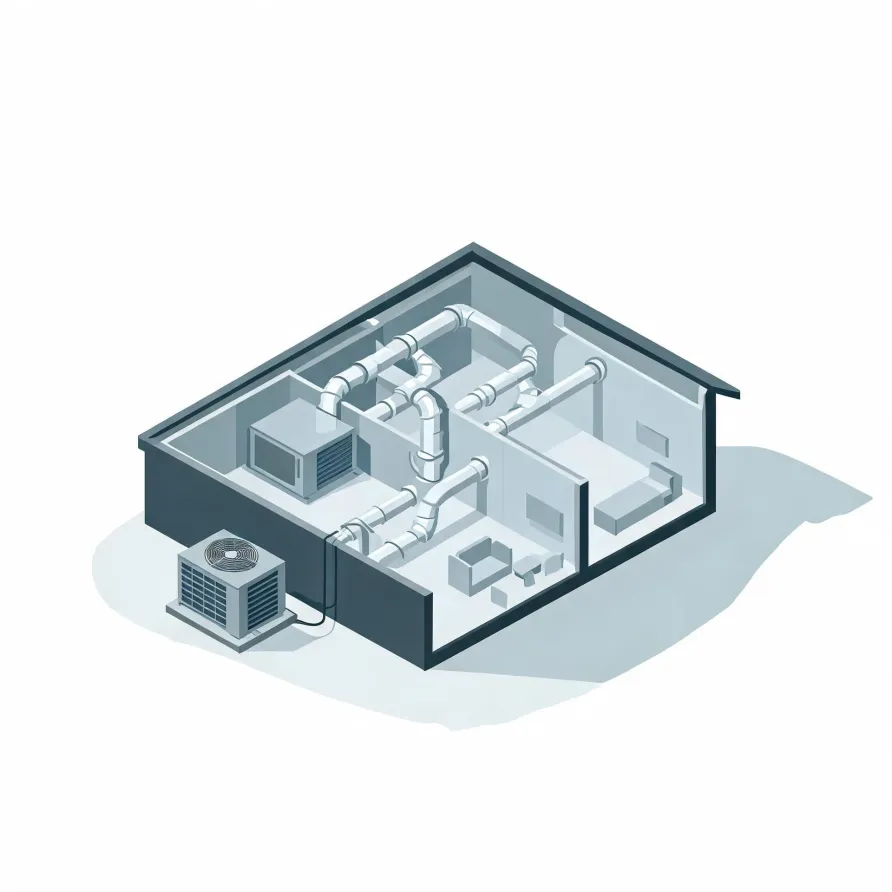
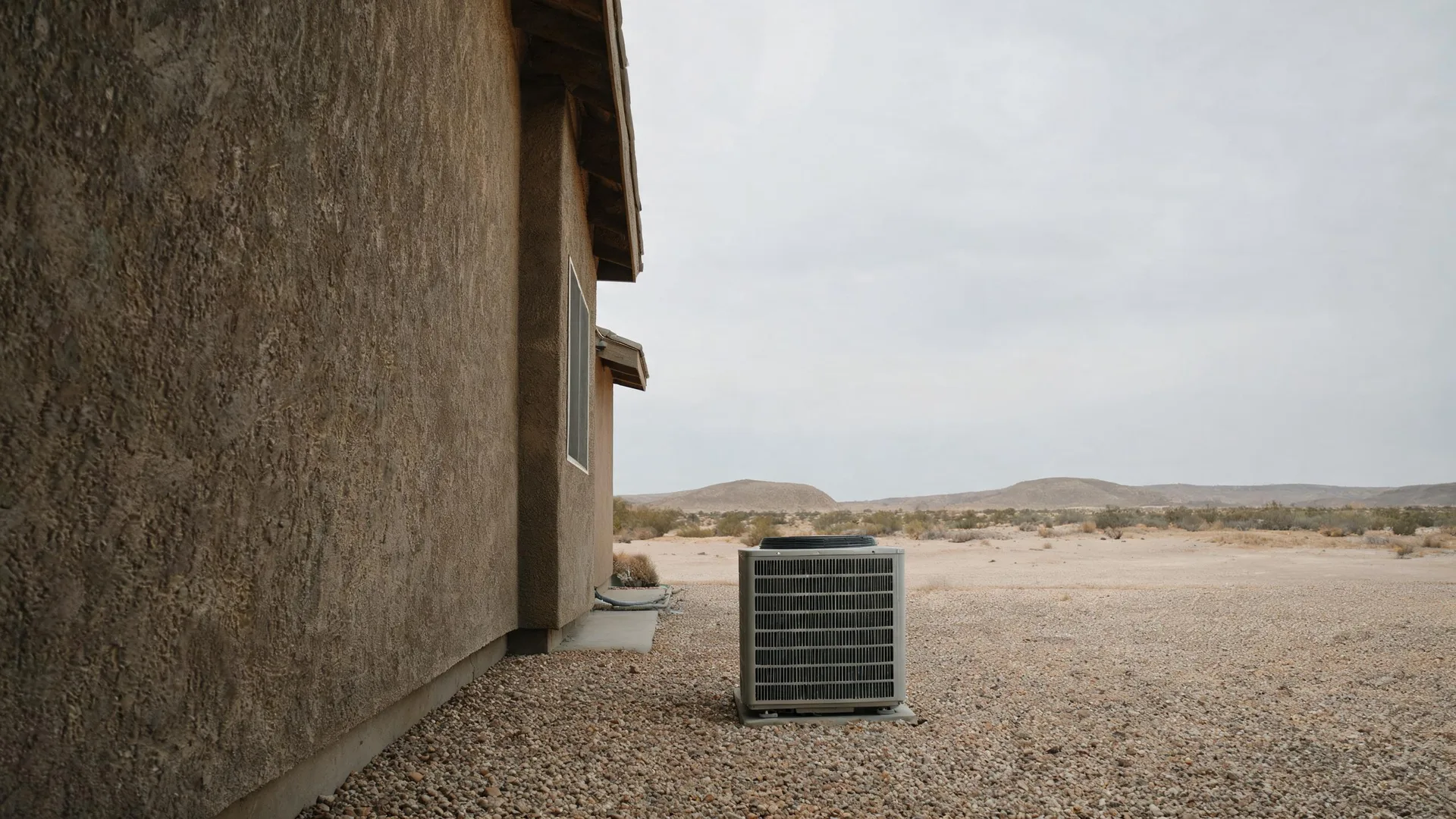
The outdoor condenser unit sits outside the house, usually on a concrete pad against an exterior wall, and it sheds heat to the outside air. The indoor air handler or furnace cabinet sits inside, most often in a utility closet, basement, or attic, and it moves conditioned air through the house. When one of these units is running poorly or not at all, it is where a contractor starts.
The copper refrigerant lines run between those two units, carrying the working fluid back and forth, and a fault in the line set shows up as ice on the coil or a system that runs but does not cool. The evaporator coil sits inside the air handler, the expansion valve controls flow into it, and the contactor and capacitor inside the outdoor unit control how the compressor and fan motor start and run. These are the pieces a contractor checks when the complaint points to a specific failure.
The drawing shows a typical central AC layout, and a licensed contractor determines which components and conditions apply to this particular home.
Get matched in Lincoln CountyLincoln County, Nevada, by the numbers
39 severe weather events were recorded in Lincoln County, Nevada between 2015 and 2024.
NOAA National Centers for Environmental Information, Storm Events Database, bulk CSV export, events 2015-01-01 through 2024-12-31.Half the homes in Lincoln County, Nevada were built in 1982 or earlier (2020-2024 ACS 5-year).
U.S. Census Bureau, 2020-2024 American Community Survey 5-Year EstimatesLincoln County, Nevada holds 2,471 housing units (2020-2024 ACS 5-year).
U.S. Census Bureau, 2020-2024 American Community Survey 5-Year EstimatesOwners occupy 75.0% of the occupied homes in Lincoln County, Nevada (2020-2024 ACS 5-year).
U.S. Census Bureau, 2020-2024 American Community Survey 5-Year EstimatesRules & Standards Governing Central AC Repair in Lincoln County, Nevada9 sourced rules and standards
What HVAC Repair Looks Like in Lincoln County
Split-system central air conditioners rated below 45,000 Btu/h manufactured on or after January 1, 2023 must meet a federal minimum of 13.4 SEER2.
Split-system central air conditioners rated at or above 45,000 Btu/h manufactured on or after January 1, 2023 must meet a federal minimum of 13.4 SEER2.
Split-system central air conditioners manufactured between January 1, 2015 and December 31, 2022 had to meet 13 SEER, the metric that preceded SEER2.
Single-package central air conditioners manufactured on or after January 1, 2023 must meet a federal minimum of 13.4 SEER2.
Space-constrained central air conditioners manufactured on or after January 1, 2023 must meet a federal minimum of 11.7 SEER2.
Federal efficiency standards for split-system central air conditioners and heat pumps are set on each certified combination of outdoor unit and indoor coil rather than on the outdoor unit alone.
Residential and light commercial air conditioning and heat pump systems assembled in the field, including mini-splits and unitary systems, may not be installed on or after January 1, 2025 using a refrigerant with a global warming potential above 700.
A field-assembled system whose specified components were all manufactured or imported before January 1, 2025 carries no installation compliance date under the refrigerant restrictions and may still be installed.
Licensing and Legal Requirements in Lincoln County, Nevada
In Nevada refrigeration and air-conditioning work is specialty contracting, and a general building contractor may not perform it without holding the licence for that specialty.
Severe Weather Events in Lincoln County
Extreme weather puts real hours on HVAC equipment: temperature swings, high winds, and power disruptions all push systems harder than steady conditions do. How often that happens here shapes what repair work looks like in Lincoln County and what a local contractor is likely to see.
39 severe weather events, 2015–2024. Source: NOAA National Centers for Environmental Information, Storm Events Database.