Why your AC compressor won't kick on in Nevada
A compressor that won't start is usually blocked by a safety switch, not broken itself. The unit senses a problem, high pressure in the lines, a tripped breaker, a capacitor too weak to give it the jolt it needs to start, and it shuts down rather than run and damage itself further. In Nevada's heat, outdoor units work against high head pressure most of the day, which puts extra strain on a weak capacitor or a contactor with worn contacts. A dirty condenser coil outside makes it worse, since the unit can't shed heat fast enough and trips on pressure before the compressor ever turns over. Low refrigerant does the same thing from the other direction. None of this clears itself. A technician needs to check the capacitor, the pressures, and the electrical contacts to find which one is stopping the compressor from starting, and fix that part rather than the whole system.




Why does my AC compressor hum but not start?
You hear the outdoor unit buzz or hum when the thermostat calls for cooling, but the fan doesn't spin and the house stays hot. It's not silent, so you figure something is trying to work, you just don't know whether to shut it off before it burns something out or let it keep trying.
That hum means the capacitor isn't giving the compressor enough of a push to start
The compressor needs a strong jolt from the start capacitor to get its motor turning. When that capacitor has weakened, the compressor gets power but not enough of a kick, so it hums and sits still instead of starting. In Nevada, where the outdoor unit works hard through long hot summers, that part wears down faster than it would somewhere milder. Left alone, the motor can overheat trying to start against that hum, and a part that would have been a simple swap turns into a failed compressor. Shut the system off at the thermostat if you hear this. Running it while it hums won't fix anything and can turn a small repair into a much bigger one.

Heat makes the compressor work harder
A compressor pushes refrigerant against higher pressure when the air around the outdoor unit is hot, and Nevada summers put that unit in direct sun for hours at a time. The hotter the coil gets, the more current the start winding needs to break the compressor loose. A capacitor that would still start the unit on a mild day can fall short at 110 degrees, and the safety switch trips before any damage is done.

The run capacitor wears down first
A run capacitor holds a charge and releases it to start the compressor's motor. It weakens gradually, not all at once, and heat speeds that wear along. A unit that struggled to start last August and ran fine all winter on gas heat often reaches the next hot stretch with a capacitor too far gone to deliver the jolt. Testing it takes a meter, not a guess, since a weak one can still show some charge.
Call Now or Wait It Out
Call now
- A compressor that trips its safety switch repeatedly can overheat the windings, and that turns a switch problem into a burned-out compressor.
- A capacitor too weak to start the compressor will only get weaker, and the longer it runs that way the harder it is on the motor.
- The outdoor unit sitting in direct Nevada sun all afternoon adds load to a part that is already struggling to start.
- Once a contractor is found, the diagnosis and repair happen on one visit instead of you living with a hot house while you wait.
- A tripped breaker that resets once and trips again points to a real electrical fault, not a fluke, and it will keep happening.
Wait and watch
- If the breaker tripped once and holds after resetting, the unit may run fine until something else triggers it again.
- A compressor that only hums for a moment and then starts normally on the next cycle isn't failing to start, so there's less urgency.
- Power is cheap in Nevada, so running the fan on its own for a day while you watch for a pattern doesn't cost much.
- Waiting means more cycles on a part that may already be marginal, and each one is a chance it doesn't restart at all.
- If it happens again within a day or two, you're back to searching for a contractor and explaining the same symptom from scratch.


Finding a pro stops being your job

One form replaces the calls you'd make to find an air conditioner pro.
No fee to send it, and nothing to sign.
What a dead compressor means at home
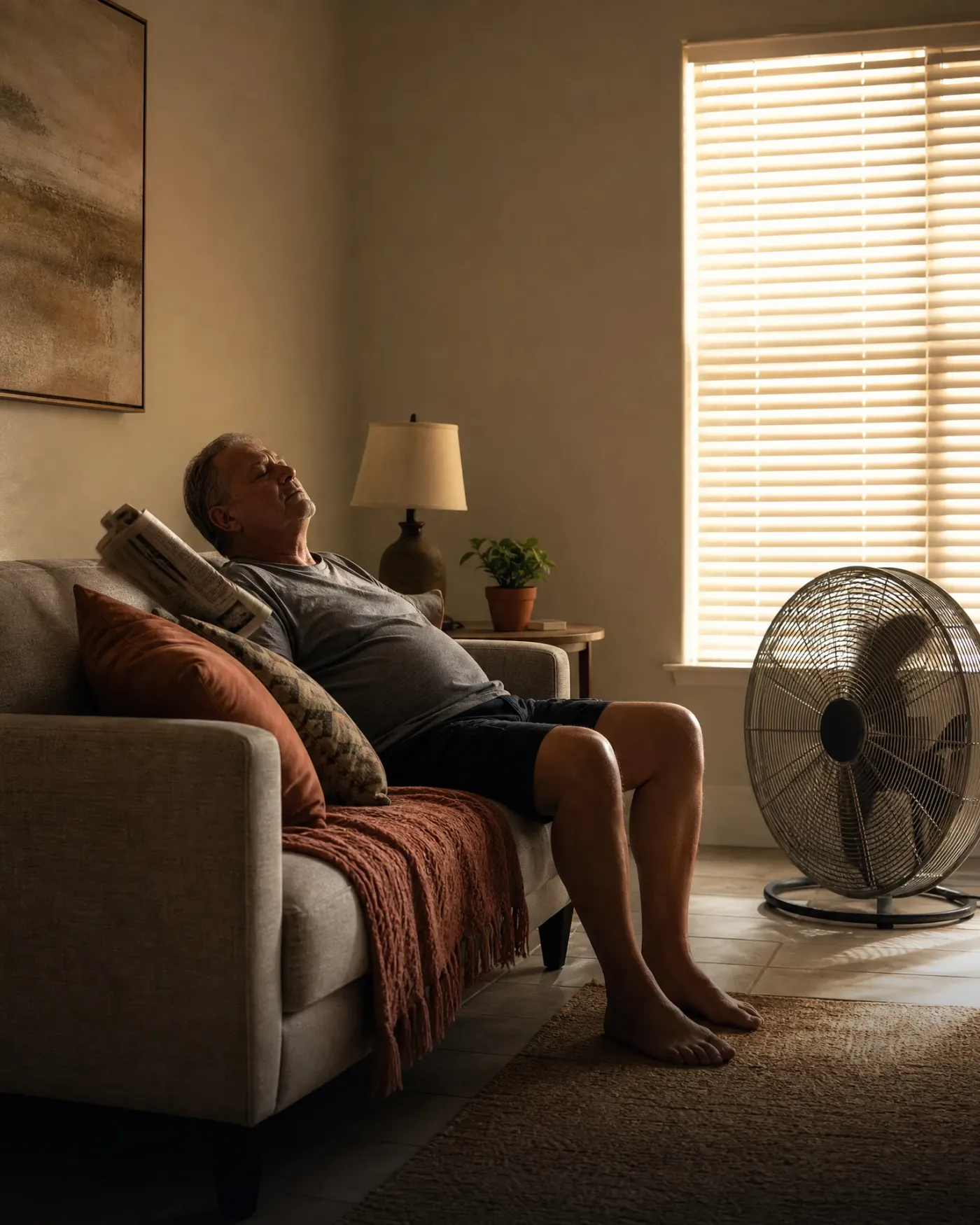
If the compressor won't start, the outdoor unit isn't moving heat out of the house, no matter what the thermostat says. The indoor fan might still blow, so air comes out of the vents, but it's not cold. In a Nevada summer that gap shows up fast, the house climbs past what the thermostat is set to within an hour or two. You'll feel it first in rooms farthest from the return, and if anyone in the house is sensitive to heat, that's where it matters most.
What it costs you to wait
Power is cheap here, so running the system harder isn't what drives the bill up. What drives it up is the compressor short-cycling, tripping its safety switch, trying again, tripping again, each attempt pulling a jolt of current without ever cooling the house. Left alone, that cycle wears on the switch itself and on the wiring behind it. A problem that today is a tripped switch or a weak capacitor can turn into a compressor that has to be replaced, and that's a different job and a different bill than the one you're facing now.


You keep running the system hoping it starts on its own, and every attempt trips the same safety switch, putting more strain on windings that were already struggling in the heat.
A contractor checks the capacitor, the pressure switch, and the breaker, finds which one is shutting the compressor down, and replaces it before the others take the same damage.
Power costs 13.26 cents per kilowatt-hour statewide
At 13.26 cents a kilowatt-hour, running the system harder than it needs to doesn't cost what it would in a lot of other states. A compressor that trips its safety switch and gets restarted over and over isn't running efficiently, it's just straining, and that strain is what burns out the windings, not the power bill.
EIA-861 2025 statewide residential average

A compressor that won't start has a reason behind it
The compressor isn't broken outright most times it won't kick on. Something tripped a switch meant to protect it, a weak capacitor, high pressure, a breaker that had enough. The fix depends on which one it is, and that takes someone who can check the capacitor, the pressure switch, and the breaker and tell you which one failed.
Finding that person is the part that eats your afternoon. Looking up contractors, calling a few, explaining the hum and the dead fan to each one, then waiting on quotes to compare. Once you send the request, that search is off your plate. You still wait for the repair and still pay for it, but you're not the one tracking down who can do it.






Let someone else find the pro
Describe what your air conditioner is doing once, in one form.
Sending the form costs nothing.