Signs of a bad AC capacitor in Nevada

Once you send the form, finding a pro is off your list.

Hand it off

What are the signs of a bad AC capacitor?

Your AC has been acting strange, maybe it hums but the fan doesn't spin, or it clicks and shuts off, or it blows warm air after running a long stretch in the heat. In Nevada, where the AC runs hard for months at a time, the capacitor is one of the first parts to wear out, and knowing what that looks like can save you a service call that goes nowhere.

A bad capacitor shows up as a unit that hums but won't start, or shuts off on its own

The capacitor stores the jolt of electricity the compressor and fan motor need to start spinning. When it weakens, the motor doesn't get that push. You'll hear a hum from the outdoor unit while the fan sits still, or the whole system clicks on and off every few minutes without ever cooling the house. Sometimes the air coming through the vents turns warm partway through a long run, especially on the hottest afternoons. In Nevada, summers push capacitors harder than almost anywhere else, because the unit runs for hours at a stretch trying to keep up with the heat. That long runtime wears down the capacitor faster, so these signs tend to show up sooner here than in a cooler climate.

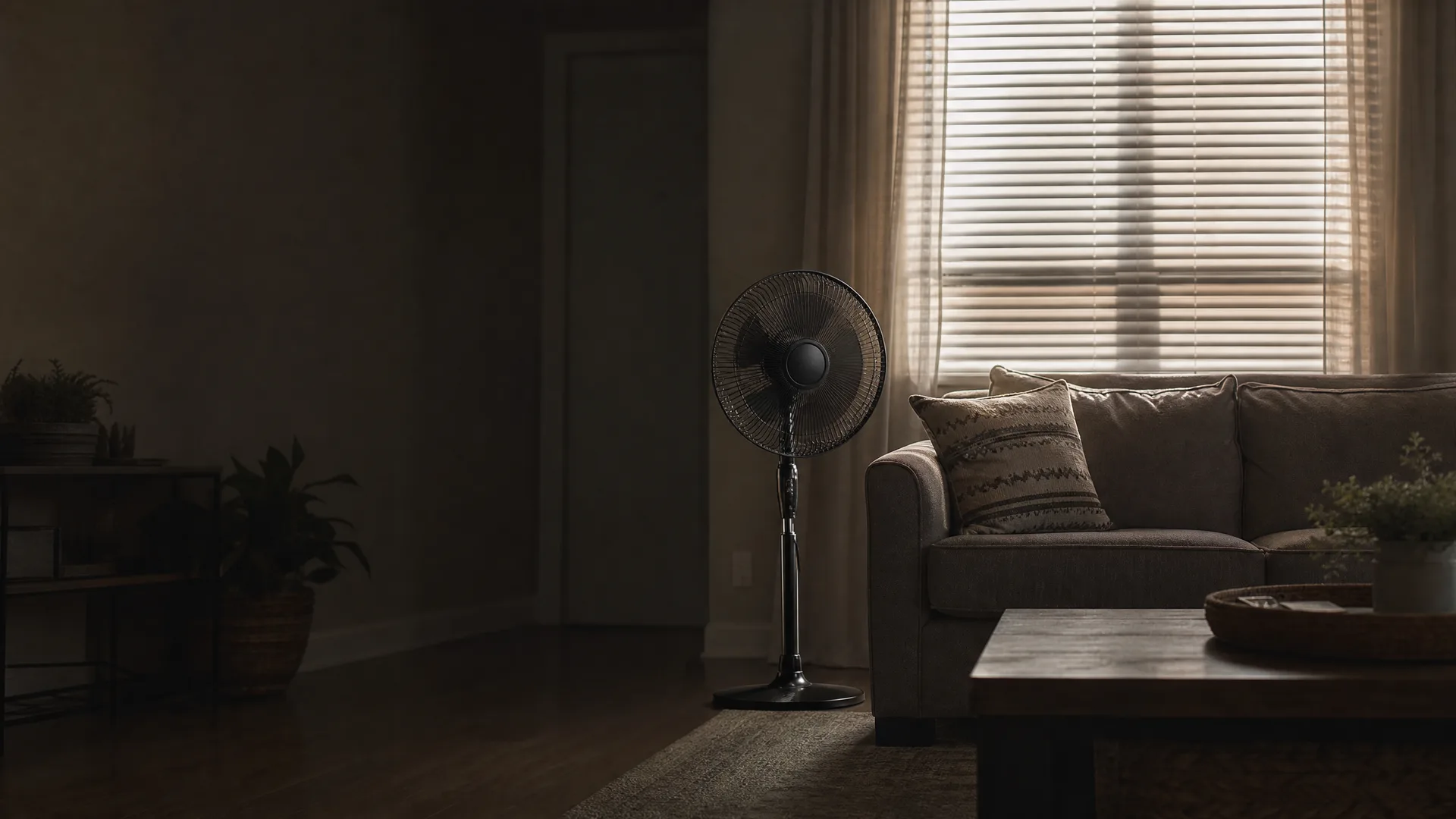
A dimly lit living room with a black pedestal fan on a wood floor beside a gray sofa with a patterned pillow, a wooden coffee table in the foreground, potted plants at left, and a curtained window with blinds behind.

It's past three in the afternoon and the blinds are shut tight against the sun. You've got the floor fan angled at the couch, doing what it can, but the air coming out of the vents has gone warm. You walk over and the unit outside is humming, that low buzz, but you can't hear the fan spinning like it should. A minute later it clicks off on its own. The house has been climbing past what the thermostat says it's set to since lunch. You put a hand near the vent again, still warm, and you know this isn't the kind of thing that fixes itself before dinner.


Power costs 13.26 cents per kilowatt-hour statewide

At 13.26 cents a kilowatt-hour, a struggling capacitor costs you more than a quick fix would. When it's weak, the compressor draws harder and runs longer trying to cool the house, and that shows up on your bill before the unit ever quits for good.

EIA-861 2025 statewide residential average

A man with grey hair and stubble in a dark sweater sits on a grey sofa indoors, looking off to the side, with a potted plant and a sunlit window behind him.
A man with gray hair, a beard and glasses, wearing a dark green sweater, sits on a gray sofa in a sunlit living room with a potted plant, table lamp and wooden sideboard behind him.
A middle-aged man with graying hair and a short beard sits on a blue sofa in a living room, looking toward a window, with a bookshelf, lamp and framed picture in the background.
A man with graying curly hair and a dark green sweater sits on a gray sofa in a sunlit living room, looking off to the side, with a framed picture, shelving, an armchair and a window with sheer curtains behind him.
  1. The capacitor stores a charge and releases it fast.

  2. That jolt spins the compressor and fan motors on.

  3. A weak capacitor sends less charge on startup.

  4. The motor strains, hums, and sometimes fails to turn.

Does this sound like what's happening at your house

You might hear the outdoor unit humming without the fan turning, or notice it clicking a few times before it gives up and shuts off. Maybe it starts fine but the air turns warm after it's run a while in the afternoon heat. Some houses get a burning smell near the unit, or the AC cycling on and off more than it used to. Any of these on their own is worth a look. Ignored through a Nevada summer, a bad capacitor usually ends with the compressor straining until it fails outright, and that's a heavier repair than the part that started it.

An outdoor air conditioning condenser unit on a concrete pad beside a house with horizontal lap siding, with a gray electrical disconnect box and conduit on the wall, mulch bed and shrub to the right, and mown grass in the foreground.

Running the way it should

The coils are clean and open, the fan spins the moment the unit kicks on, and it cools the house straight through the hottest part of the day without clicking or struggling. A capacitor doing its job is quiet work. You never think about it.

An outdoor air conditioning condenser unit on a concrete pad beside a house with light blue horizontal siding, with a shrub to the left and a conduit and disconnect box on the wall to the right.

A capacitor giving out

Dust has packed into the coil guards, and that makes the unit work harder than it should. Paired with a weak capacitor, the fan may hesitate or stall on startup while the compressor still tries to draw power. That strain is how motors burn out early.

An outdoor air conditioner condenser unit on a concrete pad beside a house with light gray horizontal siding, with mulch and green shrubs on either side and a concrete walkway in the foreground.
Before you get your air conditioner repair
A gray outdoor air conditioning condenser unit on a concrete pad beside a house with horizontal siding and a stone veneer base, with refrigerant line and electrical disconnect box on the wall and flowering shrubs to the left.
After you get your air conditioner repair
A gray outdoor air conditioner condenser unit on a concrete pad beside a house with horizontal siding and a stone veneer foundation, surrounded by mulch, ornamental grasses, and shrubs, with a conduit and disconnect box on the wall.

Hand off the air conditioner problem

Your request goes to one pro, not a list of companies.

After you send the request, you're done searching.

Hand off the search

Sending the form costs nothing.

A gray outdoor air conditioner condenser unit on a concrete pad beside a house with horizontal vinyl siding, surrounded by mulch, flowering shrubs, and lawn.
The fan spins right up and the coil stays clear, so the compressor gets the full charge it needs to start without strain.
A weathered outdoor air conditioning condenser unit on a concrete pad beside a house with light horizontal siding, an electrical disconnect box and conduit on the wall, and mulched soil on either side.
Grime packed into the fins makes the motor work harder on startup, and that load wears a weak capacitor down faster.
A woman with shoulder-length brown hair wearing a beige knit cardigan sits in a gray upholstered armchair near a window, looking off to the side with a slight smile, with bookshelves blurred in the background.
A woman and a sleeping child wrapped together in a cream knitted blanket on a couch, with a potted plant, framed photo and lit lamp in the background.

What to do with what you know

  • A hum with no fan movement, a few clicks before shutoff, or warm air after a long run all point to the same part.
  • The capacitor either holds its charge or it doesn't, and once it's weak it only gets weaker from there.
  • A tech who works on these systems all summer in Nevada's heat knows which failures show up first and checks for them in order.
  • One licensed local contractor takes the call, so you're not sorting through a stack of competing bids while your house sits warm.
  • Nevada's cheap power won't offset a compressor that strains to start every cycle, so the part gets replaced rather than nursed along.
  • Once you know the signs, the next step is getting someone qualified to confirm it and swap the part before it takes the compressor with it.

The signs line up pretty clearly. A hum without the fan turning, a few clicks before the unit gives up, warm air after it's run a long time in the heat. Any one of those points at the capacitor, and once it's weak it doesn't come back on its own. It just loses more charge the next time it starts, and the next.

You don't have to figure out how far gone it is. That part is a quick check for someone who does this work all summer in Nevada heat and knows the order these systems tend to fail in. A compressor that strains to start every cycle isn't something cheap power fixes. It just wears the part down faster, and eventually takes the compressor with it.

What happens next is simple. One request goes to one licensed local contractor, not a handful of companies competing for the job. You're not fielding calls all afternoon from people who haven't seen your unit. Someone who works on this equipment in this climate looks at what you've described, confirms it, and replaces the part if that's what it needs.

Your AC told you something was wrong. Now you know roughly what. The rest is getting someone qualified out to your house to finish the diagnosis and fix it before the compressor pays the price for a part that cost far less to replace.

At dusk, a dark board-and-batten house with a standing-seam metal roof and lit entry walkway of stone pavers, with two large outdoor heat pump units on a stone-walled pad at right and trees and hills in the background.

Air Conditioner Repair

Send one request and you're done looking

Step 1 of 3: Equipment
  • A beige upholstered armchair with an olive cushion sits in a sunlit corner beside a wooden side table holding a ceramic vase with leafy branches, under a framed abstract artwork, on a woven rug over a wood floor.
    • Describe your air conditioner job, and a local pro who handles it gets in touch.
    • Say what's going on with your air conditioner, and a pro who works on them reaches out.
  • A gray outdoor condenser unit on a concrete pad surrounded by dark gravel, beside a dark wood-sided wall with an electrical disconnect box and a stone veneer wall with a small evergreen shrub.
    • Send the request and finding a pro stops being your problem.
    • After this form, you can stop searching for an air conditioner pro.
  • A beige upholstered oversized armchair with a matching cushion and a knit throw draped over one arm, beside a round wooden side table holding a vase of greenery near a curtained window, with a framed landscape print on the wall and a woven rug on a wood floor.
    • Answer a few questions instead of calling shop after shop.
    • Describe your air conditioner job once, to one pro.
  • Sunlit living room corner with a beige upholstered sofa, cushion and knitted throw, a round wooden side table holding a white ceramic vase of leafy branches and a small wooden bowl, a framed landscape painting on the wall, and a window at right.
    • Only one pro gets your request, so you hear from one company.
    • Your request stays with one local pro.